Surgical Solutions for Obstructive Sleep Apnea
Sleep apnea is a serious medical condition in which breathing repeatedly stops and starts during sleep. The most common form — obstructive sleep apnea (OSA) — occurs when the soft tissues of the throat collapse and block the airway, sometimes dozens or even hundreds of times per night. Each episode deprives the brain and body of oxygen, fragments sleep, and places significant stress on the cardiovascular system.
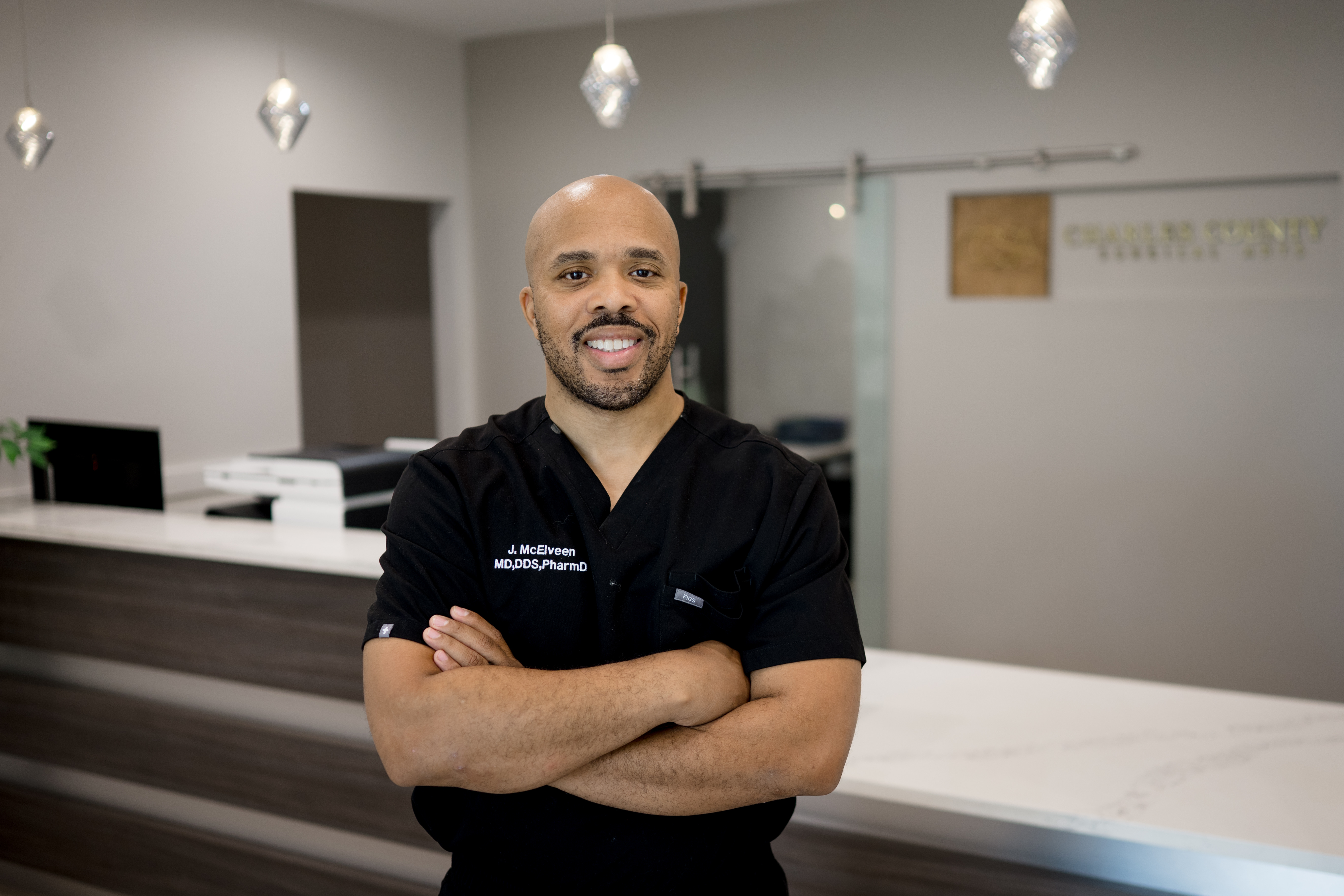
At California Oral and Implant Surgery in California, MD, Dr. John McElveen is a board-certified oral and maxillofacial surgeon who specializes in surgical treatment of obstructive sleep apnea — particularly for patients across Southern Maryland who have not found adequate relief from CPAP, oral appliances, or other conservative therapies.
What Is Obstructive Sleep Apnea?
During normal sleep, the muscles in your throat relax slightly but keep the airway open. In patients with OSA, these muscles relax too much — or the anatomy of the throat, tongue, palate, or jaw is such that the airway becomes partially or completely blocked. The brain senses the drop in oxygen and briefly wakes you to resume breathing, often so quickly that you don't remember it. This cycle can repeat 30 or more times per hour in severe cases.
OSA is classified by the apnea-hypopnea index (AHI), which measures the number of breathing pauses per hour of sleep:
- Mild: 5–15 events per hour
- Moderate: 15–30 events per hour
- Severe: More than 30 events per hour
Recognizing the Signs of Sleep Apnea
Many patients with sleep apnea are unaware of their condition. It is often a bed partner who first notices the problem. Warning signs include:
- Loud, chronic snoring — especially snoring that is interrupted by pauses and gasping
- Witnessed episodes of stopped breathing during sleep
- Excessive daytime sleepiness — falling asleep during meetings, while driving, or during quiet activities
- Morning headaches — caused by low oxygen levels and disrupted sleep
- Waking with a dry mouth or sore throat
- Difficulty concentrating, memory problems, or irritability
- Frequent nighttime urination (nocturia)
Health Risks of Untreated Sleep Apnea
Untreated OSA is far more than a sleep problem. It is a significant risk factor for:
- Hypertension (high blood pressure) — OSA is present in over 50% of patients with resistant hypertension
- Heart disease, heart failure, and arrhythmias (including atrial fibrillation)
- Stroke — 2–3× increased risk compared to those without OSA
- Type 2 diabetes — OSA impairs insulin sensitivity and glucose metabolism
- Motor vehicle accidents — drowsy driving from untreated OSA causes thousands of accidents annually
- Depression and anxiety
Diagnosis
Sleep apnea is definitively diagnosed through a sleep study (polysomnography), which may be conducted at a sleep center or through an at-home sleep test prescribed by your physician. The test records brain waves, blood oxygen levels, heart rate, breathing patterns, and body movement during sleep. Dr. McElveen works closely with referring physicians to review your sleep study results before planning surgical treatment.
Additional evaluations at our office may include:
- Clinical examination of the airway, palate, tongue, and jaw
- Cone-beam CT (CBCT) or 3D imaging to evaluate bony anatomy
- Drug-induced sleep endoscopy (DISE) in collaboration with an ENT to visualize the exact obstruction site
Conservative Treatments
Surgery is generally recommended only after conservative options have been tried. First-line treatments include:
- CPAP (Continuous Positive Airway Pressure): The gold-standard treatment — a machine delivers constant air pressure through a mask to keep the airway open. Effective for most patients, but compliance rates are low (only 40–60% of patients use it consistently).
- Oral appliances: Custom mandibular advancement devices (MADs) hold the lower jaw forward during sleep, preventing airway collapse. Effective for mild to moderate OSA and patients who can't tolerate CPAP.
- Lifestyle modifications: Weight loss, positional therapy (sleeping on your side), avoiding alcohol before bed, and treating nasal congestion.
Surgical Treatment Options
When CPAP fails or cannot be tolerated, surgical intervention offers a path to lasting relief. Dr. McElveen evaluates each patient's anatomy and obstruction pattern to recommend the most appropriate procedure.
Maxillomandibular Advancement (MMA)
MMA is the most effective surgical treatment for obstructive sleep apnea, with success rates of 85–90%. The procedure repositions both the upper jaw (maxilla) and lower jaw (mandible) forward — typically by 10–12 mm — which permanently enlarges the airway space behind the tongue and soft palate. For many patients, MMA eliminates the need for CPAP entirely.
MMA is performed under general anesthesia and requires a hospital stay of 1–2 nights. Recovery typically involves 4–6 weeks of a modified diet (soft/liquid foods) and 6–8 weeks before returning to full activity. Dr. McElveen uses 3D surgical planning and custom surgical guides for precise jaw positioning, and small titanium plates and screws hold the jaws in their new position permanently.
Uvulopalatopharyngoplasty (UPPP)
UPPP removes excess tissue from the soft palate, uvula, and throat walls to widen the airway at the level of the oropharynx. It is one of the most commonly performed sleep apnea surgeries, particularly for patients with obstruction localized to the palate area. Success rates for UPPP alone are approximately 40–60%.
Genioglossus Advancement (GA)
This procedure pulls the base of the tongue forward by advancing the small piece of bone where the tongue muscle attaches (the genial tubercle). It prevents the tongue from collapsing backward during sleep and is often performed in combination with other procedures.
Hyoid Suspension
The hyoid bone sits in the upper neck and anchors the tongue and surrounding muscles. Hyoid suspension repositions this bone forward and secures it, opening the airway behind the tongue. It is typically performed alongside GA or UPPP as part of a multilevel surgical approach.
Nasal Surgery
Nasal obstruction — from a deviated septum, enlarged turbinates, or nasal polyps — can worsen OSA and reduce CPAP tolerance. Correcting nasal breathing may improve CPAP compliance or enhance the results of other surgical procedures.
Which Surgery Is Right for You?
The best surgical approach depends on where and how your airway is obstructing during sleep. Many patients benefit from a multilevel approach — addressing the nose, palate, and tongue base in combination. Dr. McElveen conducts a thorough evaluation of your anatomy, reviews your sleep study results, and develops a personalized surgical plan. We coordinate with your primary care physician and sleep medicine specialist to ensure continuity of care.
California Oral and Implant Surgery serves patients from Lexington Park, Leonardtown, Great Mills, Hollywood, Mechanicsville, Solomons, Prince Frederick, La Plata, Waldorf, and across Southern Maryland. If CPAP isn't working for you and you're ready to explore surgical solutions for sleep apnea, request a consultation or call us at (301) 685-5688.