Corrective Jaw Surgery (Orthognathic Surgery)
Corrective jaw surgery — also known as orthognathic surgery — is a transformative procedure that repositions the upper jaw, lower jaw, or both to correct skeletal and dental irregularities that cannot be fixed with braces alone. By bringing the jaws into proper alignment, this surgery dramatically improves a patient's ability to chew, speak, and breathe while also enhancing facial symmetry and overall appearance.
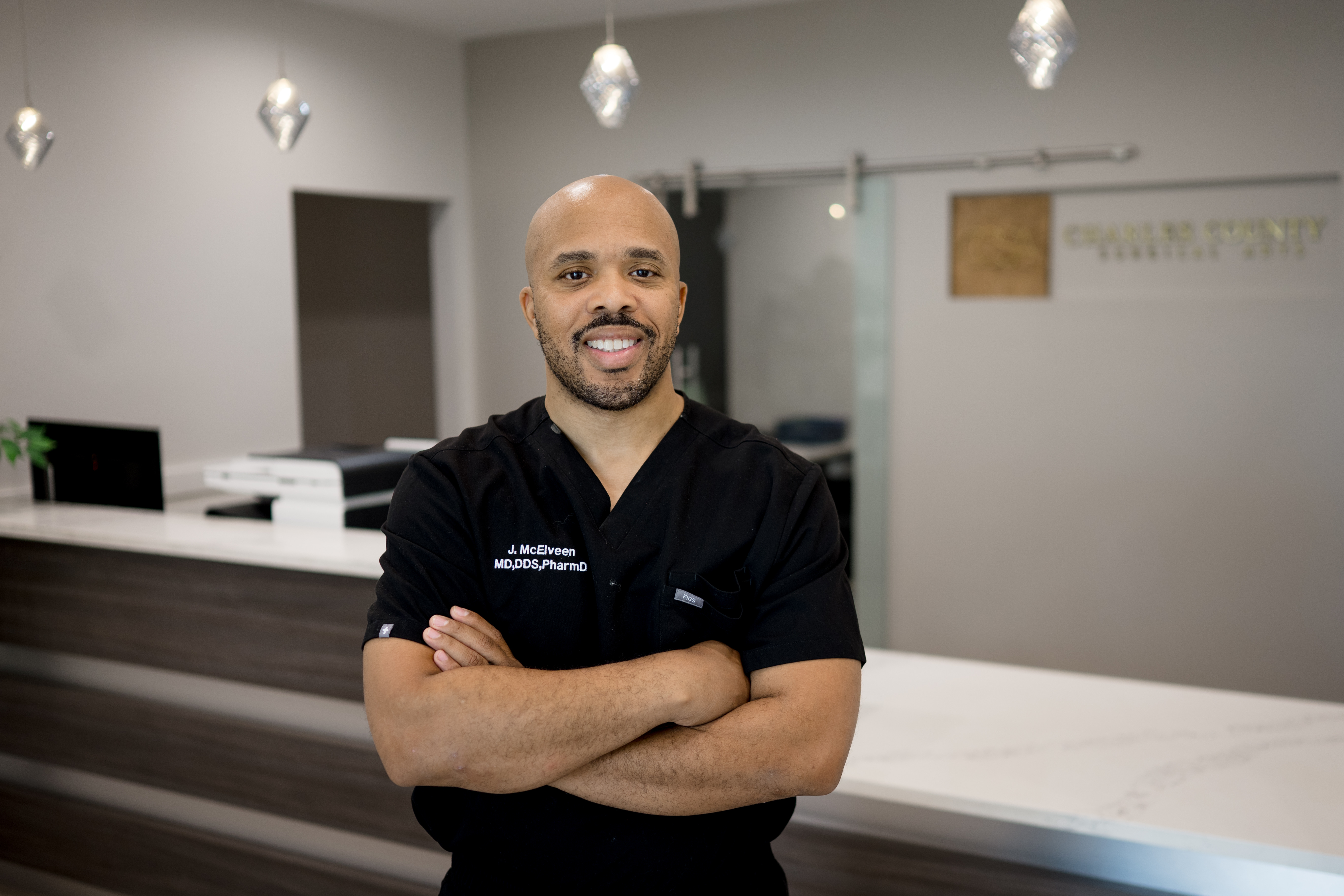
At California Oral and Implant Surgery in California, MD, Dr. John McElveen is a board-certified oral and maxillofacial surgeon who collaborates closely with orthodontists to plan and execute orthognathic surgery using 3D imaging and computer-guided surgical planning. We serve patients from Lexington Park, Leonardtown, Great Mills, Hollywood, Prince Frederick, La Plata, Waldorf, and across Southern Maryland.
When Is Jaw Surgery Recommended?
Orthognathic surgery is recommended when the upper and lower jaws are significantly misaligned — a condition that orthodontics alone cannot correct. Common indications include:
- Severe underbite (Class III malocclusion): The lower jaw protrudes beyond the upper jaw, causing difficulty biting and chewing front teeth together.
- Severe overbite (Class II malocclusion): The upper jaw extends significantly beyond the lower jaw, often causing a recessed chin appearance.
- Open bite: The front teeth do not meet when the mouth is closed, making it impossible to bite into food normally.
- Crossbite: The upper and lower jaws are misaligned laterally, causing the teeth to fit together unevenly.
- Facial asymmetry: One side of the jaw is longer or positioned differently than the other, creating a visibly uneven face.
- Obstructive sleep apnea: When jaw position contributes to airway obstruction during sleep, maxillomandibular advancement (MMA) can permanently widen the airway. Learn more about sleep apnea surgery.
- TMJ disorders: Chronic jaw pain caused or worsened by jaw misalignment. Learn more about TMJ treatment.
- Difficulty chewing, biting, or swallowing due to misaligned jaws
Types of Jaw Surgery
Le Fort I Osteotomy (Upper Jaw Surgery)
The Le Fort I osteotomy repositions the upper jaw (maxilla). The bone is carefully cut above the roots of the upper teeth, and the entire upper jaw is moved — forward, backward, up, or down — into its ideal position. This procedure corrects upper jaw deficiency, open bites, crossbites, and "gummy smiles" where excessive upper gum tissue is visible. It also improves the nasal airway in many cases.
Bilateral Sagittal Split Osteotomy (BSSO — Lower Jaw Surgery)
The BSSO is the most common lower jaw surgery. The mandible is split on both sides behind the molars, allowing the front portion of the jaw (containing the teeth) to be moved forward or backward independently of the back portion (the joint). This corrects underbites, overbites, and lower jaw asymmetry. Small titanium screws and plates hold the bone in its new position.
Bimaxillary (Double Jaw) Surgery
When both the upper and lower jaws need repositioning, a combined Le Fort I and BSSO is performed in a single procedure. This is the most comprehensive correction and is common for patients with severe facial asymmetry, complex bite problems, or obstructive sleep apnea requiring maxillomandibular advancement (MMA).
Genioplasty (Chin Surgery)
Genioplasty reshapes or repositions the chin by cutting and moving the chin bone. It is often performed alongside jaw surgery to refine the facial profile. It can correct a recessed chin, a protruding chin, or chin asymmetry, and is sometimes performed as a standalone cosmetic procedure.
The Treatment Process
Phase 1: Orthodontic Preparation (12–18 Months)
Before surgery, your orthodontist will move your teeth into a position that will allow the jaws to fit together correctly after they are repositioned. This pre-surgical orthodontic phase typically takes 12–18 months. During this time, your bite may temporarily feel worse — this is expected and necessary.
Phase 2: 3D Surgical Planning
Dr. McElveen uses cone-beam CT (CBCT) scans and specialized computer software to create a 3D virtual model of your skull and plan the exact movements of each jaw segment — down to the millimeter. Custom surgical guides and splints are fabricated to ensure the surgical outcome matches the digital plan precisely.
Phase 3: Surgery
Jaw surgery is performed under general anesthesia at a hospital or surgical center. The procedure typically takes 2–4 hours depending on complexity. All incisions are made inside the mouth — there are no visible scars on the face. The jaws are repositioned according to the surgical plan and secured with small titanium plates and screws that remain permanently and are not felt by the patient.
Phase 4: Post-Surgical Orthodontics (6–12 Months)
After surgery, your orthodontist will fine-tune your bite over an additional 6–12 months. Once the braces are removed, retainers maintain the final result.
Recovery Timeline
Recovery from jaw surgery requires patience, but most patients are pleasantly surprised by how manageable the process is. Here's what to expect:
- Days 1–3: Hospital stay for monitoring. Significant facial swelling — this is normal and peaks around day 3. Jaw is held in position with rubber bands (elastics) between the braces. Nutrition through liquids only.
- Weeks 1–2: Swelling begins to subside. Continue liquid diet progressing to very soft foods. Pain is managed with prescribed medication. Most patients take 2 weeks off work or school.
- Weeks 3–6: Swelling continues to improve. Transition to soft foods (mashed potatoes, scrambled eggs, pasta). Rubber bands may be adjusted. Many patients return to desk jobs or school at this point.
- Weeks 6–8: Gradually return to a normal diet as directed. Resume exercise and physical activity.
- Months 3–6: Residual swelling fully resolves. Numbness (a common temporary side effect) improves progressively. Final result becomes visible.
Why Choose California Oral and Implant Surgery for Jaw Surgery?
- Board-certified expertise: Dr. McElveen holds triple doctorates (DDS, MD, PharmD) and completed a rigorous oral and maxillofacial surgery residency
- 3D digital surgical planning: Every jaw surgery is planned using CBCT scans and computer-guided software for millimeter-level precision
- Comprehensive care: From initial consultation through post-surgical follow-up, you receive coordinated care between our surgical team and your orthodontist
- Full-scope surgical capability: We perform single-jaw, double-jaw, and combined procedures including genioplasty and sleep apnea surgery (MMA)
California Oral and Implant Surgery serves patients from Lexington Park, Leonardtown, Great Mills, Hollywood, Mechanicsville, Solomons, Prince Frederick, La Plata, Waldorf, and across Southern Maryland. To discuss whether corrective jaw surgery is right for you, request a consultation or call us at (301) 685-5688.